
askKynos Vet Assistant
Other AI knows pets. Kynos knows yours.
Free and built into askKynos. Tell Kynos what you're seeing, and they'll walk you through the right questions, starting from your pet's own story: age, history, medications and routines. Not a generic search result.
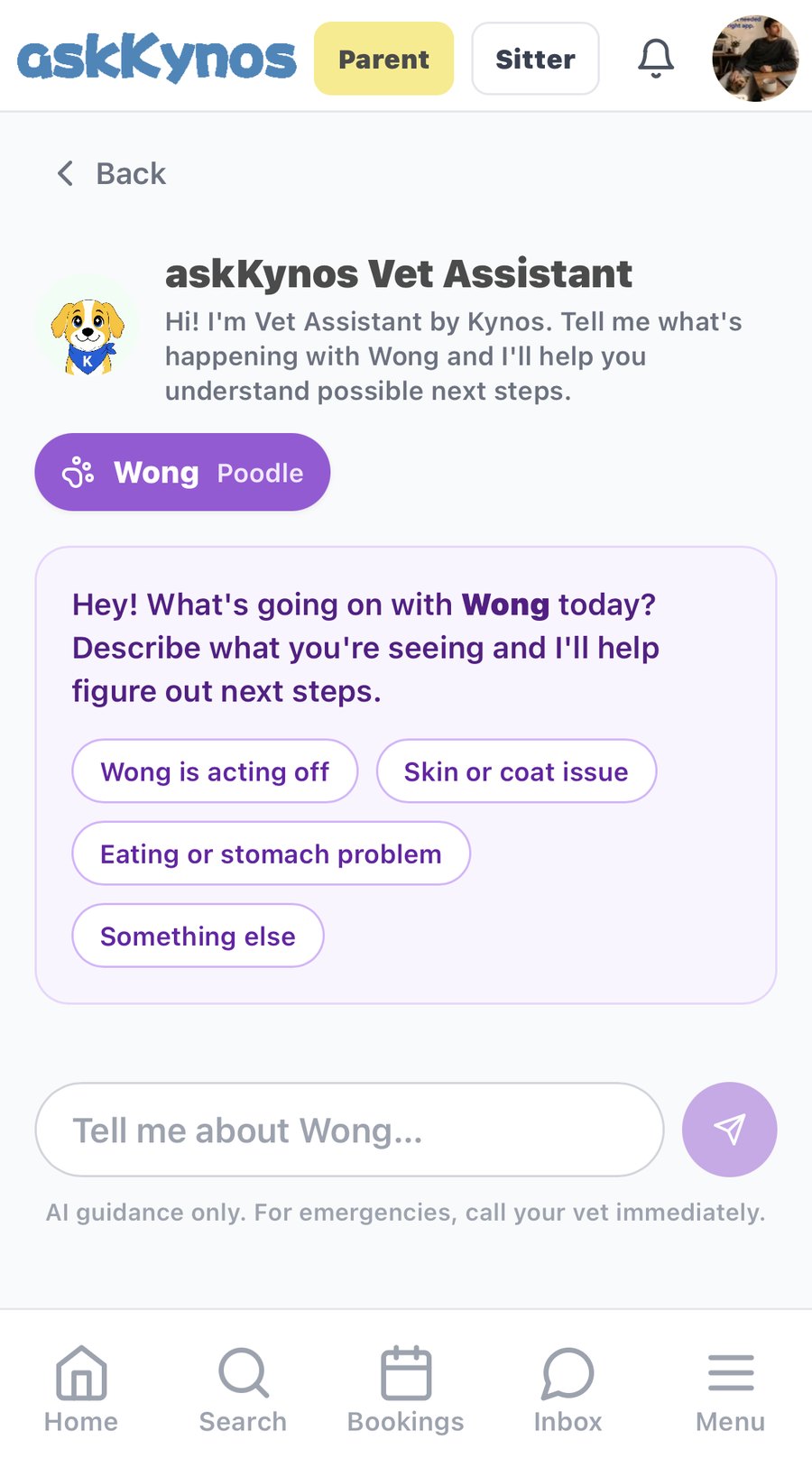
A midnight example
Wong is pacing. Where does the answer begin?
A generic search can tell you why dogs might pace at night. Useful information — but it doesn't automatically know the dog beside you. Kynos can begin with the context you've already recorded about Wong.
A generic search
“Why is my older dog pacing tonight?”
It can explain possibilities for older dogs generally. You still have to decide which details apply to Wong and remember everything else that may matter.
Ask Kynos
Start with Wong already in the room.
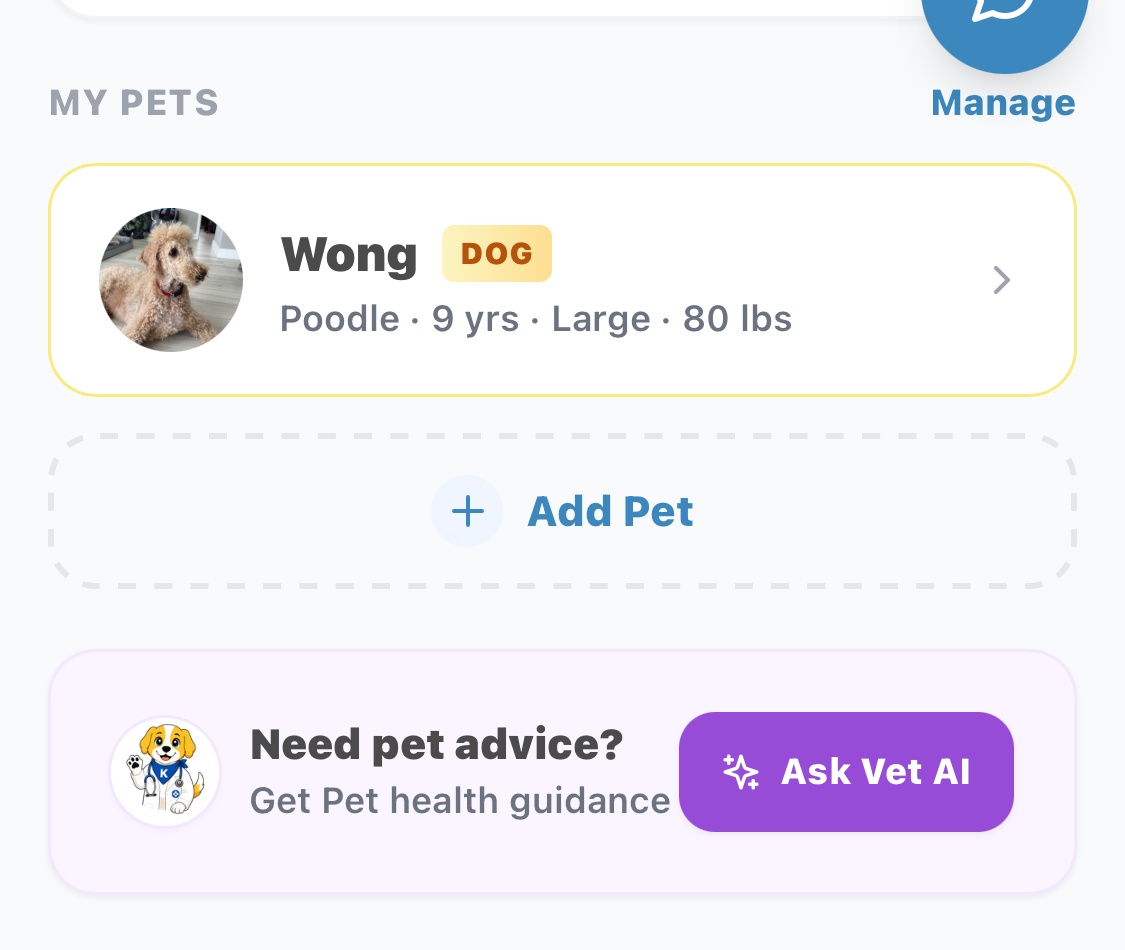
9 years old. 70 lbs. Standard poodle. His recorded medications, routines, history and the care details you've added are available as context for the question.
The difference isn't that searching is bad. It's where the answer gets to start.
The difference
Don't settle for an answer that has to start from zero.
Search and general AI can be genuinely useful. But unless you provide the context, they begin with the question in front of them. Ask Kynos guidance can begin with your pet's recorded context already in the room.
The askKynos Vet Assistant can start from your pet's profile instead: age, breed, weight, recorded medications and routines, relevant history, and the details you've already chosen to save. You don't have to re-explain your own pet from scratch every time.
The value comes from the story you build. The more useful context you record about your pet, the more context Kynos has available when a future question comes up.
This is why we ask you to fill in a real profile rather than just an email address. The profile isn't a hurdle in front of the product. It is the product.
What people actually use it for
The questions between vet visits.
Not emergencies — those go straight to your vet. The everyday uncertainty in between, where you're not sure whether something is worth a phone call.
Is this normal for their age?
Senior pets change, and it's hard to tell ordinary aging from something worth watching. Answers weigh your pet's actual age and history instead of a breed average.
What should I ask my vet?
Walk in prepared. Get a short, specific list based on what you've noticed and what's already on your pet's record, so the appointment isn't spent reconstructing history.
Should I call someone about this?
Sometimes the most useful answer is "yes, today." Kynos will tell you plainly when something belongs with a veterinarian rather than an app.
Everyday care questions
Food, exercise, travel, grooming, new routines, introducing a second pet. The ordinary stuff, answered for your household rather than in general.
Keeping the routine straight
Medication times, feeding schedules, what changed since the last stay — recorded once, then available to you and to whoever cares for your pet next.
Before you leave town
What to tell a sitter, what to write down, what to leave out. Everything already on the profile goes with your pet automatically.
Where the line is. The Vet Assistant gives general information. It doesn't diagnose, doesn't prescribe, and doesn't replace an examination. When a question needs a veterinarian, it says so and points you there — that's a feature, not a limitation.
When it matters
Calm when it's ordinary. Clear when it's urgent.
At 2 a.m. you don't need a search engine. You need something that already knows your pet, and tells you plainly how worried to be.
It already knows who it's talking about.
Age, breed, medications and history come from your pet's profile, so the answer starts where a generic search can't. When we tested it with Wong, it already knew he was on prednisone, and it flagged a possible problem with a flea treatment before anyone asked.
It doesn't cry wolf.
Most questions get a calm, everyday answer. A red urgent banner appears only when something truly calls for it, so when you see it, you know it matters.
Help is one tap away.
When something may be serious, the ASPCA Animal Poison Control Center and the Pet Poison Helpline are right on the screen, one tap to call.
You always know the next step.
Every answer is laid out the same way: the main concern, what to do now, what to watch for, and what you can do at home.
It never replaces your veterinarian. It helps you know when to call one.
Why start now
It gets better as your pet's story grows.
A profile becomes more useful as it becomes more complete. Add the details that matter — health history, medications, routines, behavior and useful care notes — and Kynos has more of your pet's real context available the next time you need help.
That's the argument for starting before you need a sitter or have a late-night question. The advantage isn't simply having had an account longer. It's having taken the time to build a story about your own pet that other tools were never designed to keep.
Questions about the Vet Assistant
The short answers
Is it really free?
Do I have to book a sitter to use it?
Is this a veterinarian?
How is this different from a general AI chatbot?
What does it know about my pet?
Does it work for cats?
Tell Kynos what's going on tonight.
Free, built in, and it starts knowing your pet the moment you tell it.


Prefer your computer? Use askKynos in your browser →